

Short time-to-market
- Respond dynamically to changing requirements, even during the production phase
- Test machinery and machine modules offline before delivery using decentralized logic
- Rapid design phase through reuse of existing modules


With a team of individual specialists, you reach your goal faster. Stay agile and always ready for dynamic changes.
Rigid, centralized automation systems make adjustments difficult, increase cabling costs, and limit the flexibility of modern production facilities. TURCK addresses this challenge with decentralized automation by using compact I/O modules, IP67-rated fieldbus components, IO-Link devices, and multi-protocol Ethernet technology directly at the field level. Control logic, data acquisition, and communication are implemented close to the process and integrated into existing controllers and IIoT systems via open interfaces. This architecture reduces installation and engineering effort, simplifies scaling and retrofitting, and enables modular machine concepts. Companies benefit from higher plant availability, faster commissioning, increased flexibility, and lower total costs in manufacturing and intralogistics.
The most successful battery manufacturers rely on TURCK technology. Benefit from the data of your automation system for optimum production efficiency and highest availability with impeccable product quality.
Battery production is rapidly gaining momentum around the world. The energy and mobility transition are the drivers of this development. One thing is certain: the next 20 years of battery production will differ dramatically from the last 20 years.
The processes and technologies for the production of battery cells will continue to develop in the coming years. New raw materials, changed mixing and coating processes or new processes for calendering and winding, there will be changes. But how can battery cell manufacturers prepare existing and future production plants for this dynamic phase and dramatically shortened innovation cycles?
TURCK's response: with smart automation technology, data-driven process optimization, and flexible production facilities. RFID identification technology helps increase the output of existing systems while improving process reliability and product quality. Smart automation with condition monitoring detects problems at an early stage, enabling predictive maintenance that permanently increases availability and, in turn, overall equipment efficiency (OEE). Decentralized automation technology with robust, non-cabinet-bound IP67 systems makes it easier to set up modular production systems where machines can later be regrouped or capacities relocated.
A well-established team of competent people is often more efficient than a strictly hierarchical organization. If everyone knows their goals and tasks, then a central figure in charge doesn't need to make all the decisions.
Efficiently automated machines and plants minimize costs, ensure product quality and ensure high availability in production. Break down rigid hierarchies and shift competencies to the local level. Decentralized automation also reduces commissioning and time-to-market, and simplifies the expansion or relocation of production resources. Modularize your plants and machines and see how much freedom this gives your production.
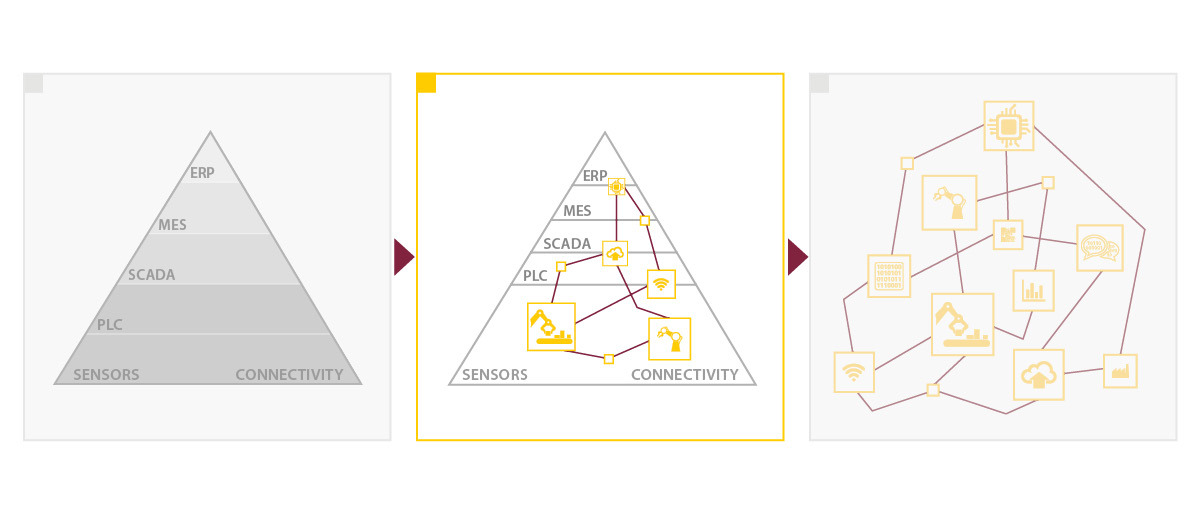
Sensors that detect machine wear themselves, RFID tags that tell the machine whether it is configured correctly for the next work step and what it then has to do, or an I/O module that decides independently to operate an actuator: the present and future of automation can no longer be located in the levels of the classic automation pyramid. Decentralized pre-processing reduces machine data to valuable information and thus lays the foundation for a new era of automation.
Until now, automation has been dominated by hierarchies and long decision-making paths, but the levels are becoming increasingly permeable.
This whitepaper explores the world of decentralized automation and highlights the opportunities offered by decentralized solutions for mechanical engineering and logistics.